Bitsight and Lokker report

Support for Your Privacy Risk Assessment Report

We want to provide context for how best to interpret your Privacy Risk Assessment Report. Your report provides insights for both privacy and cybersecurity risks. Below you will find general report details, or you can visit our tailored guidance specific to your use case.

Bitsight and Lokker report - Privacy Risk Assessment Report cover

Privacy Risk Report Details and Definitions

Have questions about your report? Here's a clear breakdown of each element: what we check, why it matters, how we calculate it, and how to act on your results.

Privacy Risk by Category

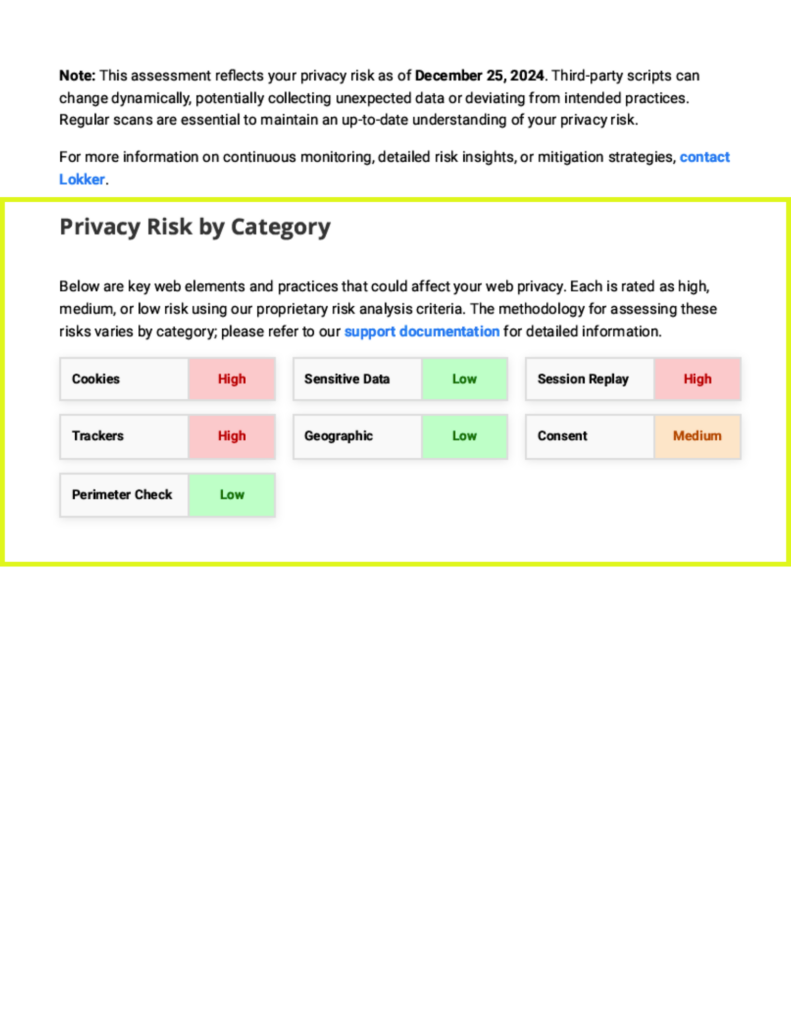
Privacy Risk by Category

Lokker's Web Privacy Risk Score™ offers organizations a clear and quantifiable way to evaluate, identify and mitigate web privacy risks that may result in a privacy breach, enforcement action or lawsuit. This tool provides a detailed view of risks across website domains or portfolios of domains, allowing companies to pinpoint risks by webpage, severity, and frequency.

Lokker's risk model uses advanced scanning capabilities to evaluate websites without requiring integration or code modifications. The baseline risk scores are based on an analysis of over 80,000 websites across various S&P industry sectors. The scoring model measures overall risks and breaks them down into seven specific categories described below.

Cookies2 focus areas

Cookies represent one of the most fundamental mechanisms for data sharing on websites. They can store user information that is later shared with or accessed by third parties. Risks in this category are identified under the following conditions: third party cookies were set before obtaining explicit user consent, or third party cookies were loaded without obtaining explicit user consent.

Data being stored in a third-party cookie indicates that data has been shared with a third party. As a result, the cookie can later be used to reference this data for showing ads to the user, merge with data shared from other sites or other online/offline transactions.

First-party cookie risk

This category also includes first party cookies that were set before or without obtaining explicit user consent. First-party cookies are generally intended for website use, while third-party cookies are for use by third parties. However, a JavaScript workaround exists that allows third parties to set first-party cookies, creating first-party cookie risk.
Why it matters

Cookies facilitate data sharing between websites and third parties. This data can be used for targeted advertising, user profiling, or merging with other datasets, potentially exposing users to privacy violations.

Sensitive Data2 focus areas

This category evaluates the presence and sharing of sensitive user information, such as personally identifiable information (PII), financial details, or health-related data. The type of data being shared affects the risk score depending on the sensitivity of the data, as does the type of site and page factors on which it is found. For example, sending credit card data is more sensitive than sending the user's first name.

How it's assessed

Lokker tests for data loss by filling out forms with fake data, and then does a lookup to see if any of that data is sent to a third party, and if so, where did it go and to whom.

Why it matters

Unauthorized sharing of sensitive data increases the risk of identity theft, fraud, and regulatory penalties under laws like GDPR, CCPA/CPRA, and related state laws.

Session Replay1 focus areas

The session replay risk category includes session replay tools from third parties like Dynatrace or Hotjar being detected on a website. These tools record user interactions (e.g., clicks, keystrokes, and navigation) to help site owners understand user behavior. Risk occurs when data is being shared with these third parties, especially when the proper notice has not been given and/or the proper consent has not been received from the user.

Why it matters

When sensitive user interactions are recorded and shared without consent, it can lead to significant privacy concerns and legal repercussions.

Trackers6 focus areas

This category assesses third-party tracking technologies embedded on your website, which can monitor user behavior and share data with external entities which you may not have approved for sharing.

Fingerprinting

Scripts taking a unique "fingerprint" of a user's browser in order to track their activity across different websites. Lokker looks at all of the methods called by a script and assigns a weighting to the ones commonly used for browser fingerprinting.

Trackers detected

The presence, number and type of third-party code (Trackers) found on your site affects the score.

User IDs (keys) sent

Lokker assesses the data sent to a third-party to check if there is any high risk data like user_ids sent back to the third party.

User behavior sent

Lokker assesses the data sent to a third party to check if there is any sensitive behavior sent back to the third party.

Third-party iframes found

This check looks for iframes created on your site by third parties. When these are found the risk score is increased accordingly.

Why it matters

Trackers can compromise user privacy and undermine trust by sharing data without user awareness or consent.

Geographic3 focus areas

This category evaluates the geographic location of third-party servers receiving data from your site. Some countries are considered high-risk due to their regulatory environment, cyber practices, or political climate.

High-risk countries

Russia, China, Belarus, Venezuela, Cuba, Turkmenistan, Syria, Eritrea, North Korea.

How it's assessed

Lokker examines the IP addresses of third-party servers to determine their geographic location.

Why it matters

Data sent to high-risk jurisdictions may be vulnerable to surveillance, hacking, or misuse, leading to significant privacy concerns.

Consent2 focus areas

This category examines whether your website complies with legal requirements for obtaining user consent.

What we check

Is the user presented with a privacy consent banner when they enter your site? Do the pages on your site have the regulatory message for 'Do Not Sell My Information'? If either of these are true, the score risk is increased.

Why it matters

Failure to provide proper consent mechanisms can lead to legal penalties under privacy regulations such as GDPR and CCPA/CPRA. Under California law as amended by the CPRA, that includes ensuring opt-out of sale and sharing is functional and GPC signals are honored.

Perimeter Check2 focus areas

This category includes checks against the domain name used by any third-parties on your site and their associated risks.

What we check

Malicious Domains (cross-referenced against a malware database), Security certificate issues, and Domain registration age (registered within the past 30 or 180 days).

Why it matters

Newly registered domains or those with inadequate security measures can pose significant risks to user data and site integrity. By breaking down privacy risks into these categories, Lokker's Web Privacy Risk Score™ provides actionable insights to help organizations safeguard user data, enhance compliance, and build trust and integrity.

Privacy Risk by Category - report screenshot
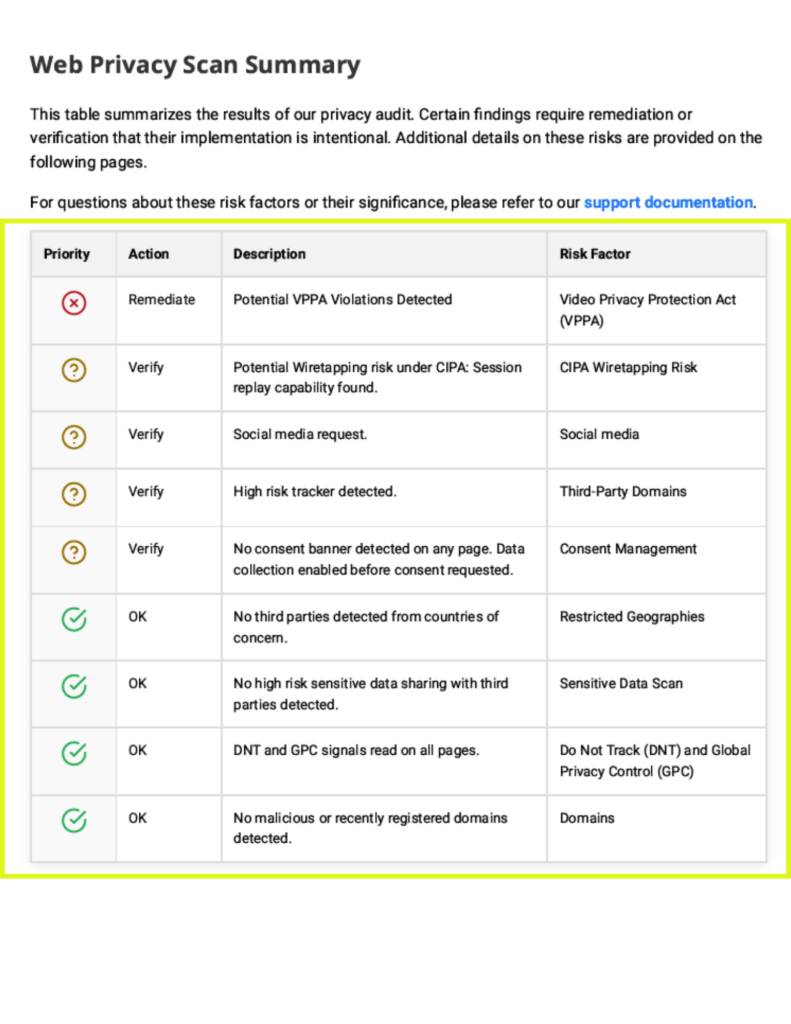
Web Privacy Risk Summary - report screenshot

Risk Summary

Understanding the Web Privacy Risk Summary

CIPA Wiretapping Risk

Why We Look for This

The California Invasion of Privacy Act (CIPA) prohibits wiretapping, which may occur when session replay tools record user interactions without proper consent. Having a session replay tool on your site, without 100% correct notice and consent creates privacy risk. Session Replay = Wiretapping tools.

How We Check for This

We scan your website to identify session replay tools and assess whether they are active or collecting data.

Understanding the Report Results

No session replay tools were detected. No risk was identified.
Potential wiretapping risk under CIPA: Session replay capability found. High risk. Confirm tools are disabled or ensure proper consent is collected.
Consent Management

Why We Look for This

Over 10 states and 120 countries around the world have consumer data privacy laws which impact if and how your business uses a consent banner.

How We Check for This

The Lokker scanner simulates a user going to your site and checks if a consent banner is presented on all the scanned pages.

Understanding the Report Results

Consent banner found on all pages. No risk was identified.
No consent banner detected on >90% of pages. Data collection enabled before consent requested. The majority of your pages are missing a consent banner. Data is being collected by one or more third parties prior to receiving consumer consent.
No consent banner detected on any page. Data collection enabled before consent requested. A consent banner does not exist on your site. Data is being collected by one or more third parties without receiving consumer consent.
Domains

Why We Look for This

Malicious domains which contain malware can indicate privacy risk or a data breach. Recently registered domains are considered risky because cybercriminals often use newly registered domain names to host malicious content like phishing sites, malware distribution points, or command-and-control servers.

How We Check for This

Malicious Domains: We check third parties on your site against a database of known malicious sites. Recently Registered Domains: We check the domain registration date of all third parties on your site.

Understanding the Report Results

No malicious or recently registered domains detected. None of the third parties on your site is using a recently registered domain or a domain which has been flagged as malicious.
Third party malware or recently registered domains detected. Recently registered domains or a domain which has been flagged as malicious has been detected. Take action to verify and remediate as needed.
Restricted Geographies

Why We Look for This

Tags on your site from servers in certain high risk countries, as designated by the US government, are considered high-risk due to their regulatory environment, cyber practices, or political climate.

How We Check for This

Lokker examines the IP addresses of third-party servers to determine their geographic location from any of these "Countries of Concern": Russia, China, Belarus, Venezuela, Cuba, Turkmenistan, Syria, Eritrea, North Korea.

Understanding the Report Results

No third parties detected from countries of concern. None of the third party tags on your site originate from a country of concern.
Restricted Geographies: Third parties detected from countries of concern. Some of the third party tags on your site originate from a country of concern.
Sensitive Data Scan

Why We Look for This

Unauthorized sharing of sensitive data increases the risk of identity theft, fraud, and regulatory penalties under laws like GDPR, CCPA/CPRA, and related state laws. The CPRA introduced a dedicated category of sensitive personal information with heightened protections, making form data and health-adjacent data sharing an especially high-priority compliance area.

How We Check for This

Lokker tests for data loss by filling out forms with fake data, and then does a lookup to see if any of that data is sent to a third party, and if so, where did it go and to whom.

Understanding the Report Results

No high-risk sensitive data sharing with third parties detected. High-Risk Data: Includes personal details such as name, address, email, phone number, credit card information, medical terms, and social security numbers.
Extremely sensitive data sent to third party. Extremely Sensitive Data: Flags are triggered if passwords, credit card numbers, or SSNs are shared with third parties.
Social Media

Why We Look for This

When third party tags from some social media are used on healthcare sites, privacy risk is increased.

How We Check for This

If the site has been designated a healthcare site in the Lokker system configuration, then the Lokker scanner examines the site content to determine if any third party tags originate from Social media, e.g. Meta (Facebook/Instagram), TikTok, LinkedIn, Snapchat, or Pinterest.

Understanding the Report Results

No social media domain requests detected. The use of a social media tag on a healthcare site has not been detected.
Meta pixel found on a healthcare page. Social media request on a healthcare site.
Meta and TikTok pixels found on a healthcare page. The use of a social media tag on a healthcare site has been detected.
Third-Party Domains

Why We Look for This

This category assesses third-party tracking technologies embedded on your website, which can monitor user behavior and share data with external entities which you may not have approved for sharing. This can compromise user privacy and undermine trust by sharing data without user awareness or consent.

How We Check for This

We look for fingerprinting scripts that take a unique "fingerprint" of a user's browser. We consider the presence, number and type of third-party trackers found on your site. We look for user IDs (keys) sent to third parties, user behavior being sent, and the presence of third-party iframes on your site.

Understanding the Report Results

No high risk tracker detected. None of the checks listed above were found to be true.
High risk tracker detected. Trackers that have been identified as malicious or named in a lawsuit. Significantly more 3rd party domains than S&P 500 average, having a large number of trackers on your site could indicate risk.
Video Privacy Protection Act (VPPA)

Why We Look for This

The Video Privacy Protection Act (VPPA) prohibits the disclosure of personally identifiable information about users' video-watching habits without explicit consent. It is a federal law originally passed to protect people's video rental histories, but has been repurposed by plaintiffs to file cases against companies.

How We Check for This

Lokker looks for combinations of events where a consumer views a website with video content and the consumer's video-watching behavior is shared with a third party without explicit consent. We also analyze how pixels are configured to see if they share sensitive video analytics such as video titles or watch times with third parties.

Understanding the Report Results

No VPPA Violations Detected. There are NO pages on your site with video content that is being shared with third parties without user consent.
Potential VPPA Violations Detected. There are one or more pages on your site with video content that is being shared with third parties without user consent.

Critical Risks

Understanding Critical Risk Remediation

Risks that have been identified as critical have the potential to result in monetary or reputation damages to your company. These risks should be mitigated immediately.

Domain Hijacking

Domain hijacking is the unauthorized takeover of a domain name, usually by exploiting security weaknesses or administrative loopholes. Attackers gain control of a domain and can redirect traffic, disrupt services, or use it for malicious activities.

  • Traffic Redirection: Attackers redirect visitors to malicious websites.
  • Brand Reputation Damage: Users may lose trust in the hijacked domain.
  • Email Spoofing & Phishing: Cybercriminals can send fake emails from the hijacked domain.
  • Data Theft: If the domain hosts a website, user data may be compromised.
  • Financial Loss: Ransom demands or loss of business due to website downtime.
AttributeAdditional InformationDescription
RiskCritical is the highest level of risk.Critical
SpreadThis is the number of scanned pages (20) and the number of pages on your site (3) with this risk was found.Found on 3 of 20 pages inspected
DescriptionThis is the act of changing the registration of a domain name without the permission of its original registrant.Domain Hijacking
Example PageThis is an example of a page with a hijacked domain. There may be additional pages with risk.https://farrelldistributing.com/rtd-cocktails
Example Request URLThe complete URL of the third party which has hijacked this page.https://polyfill.io/v2/polyfill.min.js?features
CountNumber of pages where this risk was found.3
Pages ImpactedThe names of one or more pages on your site where this risk was found.https://example.com/beer/, https://example.com/non-alcoholic, https://example.com/rtd-cocktails
Extremely Sensitive Data Sent to Third Party

Lokker performs checks to prevent the sharing of highly sensitive data with third parties. This includes personal information such as passwords, social security numbers, and credit card information, which can be used to compromise an individual's privacy or commit identity theft.

AttributeAdditional InformationDescription
RiskCritical is the highest level of risk.Critical
SpreadThis is the number of scanned pages (20) and the number of pages on your site (1) with this risk found.Found on 1 of 20 pages inspected
DescriptionExtremely sensitive data has been shared with a third party, including passwords, credit card numbers, or social security numbers.Use extreme caution when collecting and sharing this information. Review your agreement with this partner to ensure appropriate security measures. If unsure, block data sharing via the Manage Third Parties dashboard.
FieldThis identifies the type of data shared.Password
DomainThe third-party website receiving the data. Engage your engineering team to understand why.formstack.com
ScriptWhen a script is used to share data, this shows the user action that initiates the sharing.Button Click
Target URLThe URL of the third-party website receiving the data.https://eternityweb.formstack.com/forms/index.php
Fake Data FieldLokker simulates a "fake" user entering data on your site for testing. This is the fake data used.orBOxAAzW6d@Ejm7
Example PageAn example of a page where sensitive data is sent to a third party.https://farrelldistributing.com/rtd-cocktails
CountNumber of pages where this risk was found.1
Pages ImpactedNames of the pages on your site where this risk was found.https://farrelldistributing.com/request-a-donation
Meta Pixel Found on Healthcare Page

This risk occurs when a pixel from Meta is placed on a page that provides health care information to the user. The Meta pixel sends data to Facebook including the Facebook user ID and details of the page viewed. Because Facebook also has access to email addresses and other personal information, it can link a real person to the specific healthcare information viewed.

AttributeAdditional InformationDescription
RiskCritical is the highest level of risk.Critical
SpreadThis is the number of scanned pages (20) and the number of pages on your site (3) with this risk was found.Found on 3 of 20 pages inspected
DescriptionWhile this risk is referred to as the Meta Pixel risk, it is the Facebook website that is receiving information from your site.We detected the Meta Pixel on the page, on a website we believe to be in a higher risk industry.
IndustryThe industry classification of the page on your site with the risk.Healthcare - Medical Devices and Supplies
Example PageThis is an example of a page on your site with the Facebook pixel. There may be additional pages with risk.https://blueskybio.com/pages/bio-cut
Example Request URLThe complete URL of the third party which is receiving information from your site.https://www.facebook.com/tr/?id
Meta Pixel IDFacebook uses this ID to identify the user.232570173945555
CountNumber of pages where this risk was found.3
Pages ImpactedThe names of one or more pages on your site where this risk was found.https://example.com/pages/about-us, https://example.com/pages/bioconus-12, https://example.com/pages/bioconus-12_0
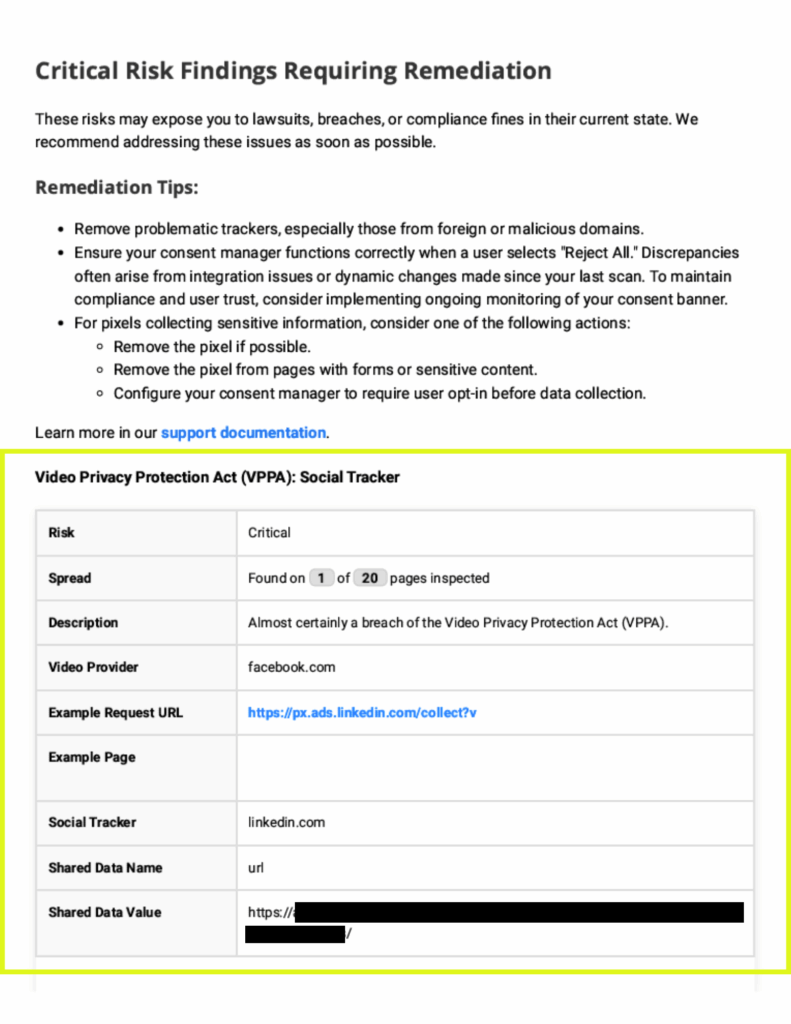
Potential VPPA Violations Detected

The Video Privacy Protection Act (VPPA) risk arises when a website with playable video content shares user data with a third-party that possesses personally identifiable information (PII) of those users. The legal risk exists because the third party gains knowledge of the email addresses (or other PII) of individuals who had access to the video on the website. The VPPA risk occurs when 3 conditions simultaneously exist: a website with video content, data sharing with a third party, and the third party possessing PII of the user.

  • User Awareness: Users may not be aware that their video viewing activity is being shared with third parties and linked to their PII. This lack of transparency raises privacy concerns.
  • Data Control: The website owner has a responsibility to control the data that is shared with third parties and to ensure that user privacy is protected.
  • Compliance: Websites that include video content must be mindful of VPPA compliance and take steps to mitigate the risk of data sharing and privacy breaches.
AttributeAdditional InformationDescription
RiskCritical is the highest level of risk.Critical
SpreadThis is the number of scanned pages (20) and the number of pages on your site (1) with this risk was found.Found on 1 of 20 pages inspected
DescriptionVPPA is the law which could be used to bring legal action.Almost certainly a breach of the Video Privacy Protection Act (VPPA).
Example PageThis is an example of a page containing the video and a tag which shares data. There may be additional pages with risk.https://example.com/2023/02/08/drayage/
Video ProviderHosting website of the video found on the page.facebook.com
Social TrackerThird party which is informed that the user is on a page with a video.linkedin.com
Shared Data NameParameter used in the URL sending information to a third party.video (px.ads.linkedin.com/collect?video=titanic)
Shared Data ValueThe value of the data being shared.titanic (px.ads.linkedin.com/collect?video=titanic)
CountNumber of pages where this risk was found.1
Pages ImpactedThe names of one or more pages on your site where this risk was found.https://example.com/2023/02/08/drayage/, https://example.com/shipping/
GPC

The Global Privacy Control (GPC) is a setting that can be enabled within a user's web browser. When active, it transmits a signal to websites when a user visits the site, communicating the user's preference for privacy, indicating that their personal data should not be sold or shared with third parties. Lokker detects if your website is honoring the GPC signal. If your website is not respecting GPC, it is flagged here. There are potential legal and regulatory actions for this including fines, penalties, and lawsuits.

AttributeAdditional InformationDescription
RiskCritical is the highest level of risk.Critical
Page CountThis is the number of scanned pages (20) and the number of pages on your site (3) with this risk was found.Found on 3 of 20 pages inspected
Example PageThis is an example of a page which is not checking for GPC.https://example.com/careers
Example Request URLThe complete URL of the page which is not checking for GPC.https://polyfill.io/v2/polyfill.min.js?features
CountNumber of pages where this risk was found.3
Sensitive Data Sent to Third Party

Lokker checks to ensure that sensitive data is not being shared with a third party. This type of data includes: first name, middle name, last name, full name, password, email address, company name, phone number, credit card, street address, state, city, country, zip, sex, diagnosis, credit card name, credit card expiry, or age. This type of personal information can be used to expose an individual's private information or help steal their identity.

AttributeAdditional InformationDescription
RiskCritical is the highest level of risk.Critical
SpreadThis is the number of scanned pages (20) and the number of pages on your site (1) with this risk was found.Found on 1 of 20 pages inspected
DescriptionSensitive data has been shared with a third party.Use extreme caution when collecting and sharing this information with a third-party. Review your agreement with this partner to ensure they have appropriate security measures. If you don't recognize the partner receiving the data, block data sharing through the Manage Third Parties dashboard.
FieldThis identifies the type of data which has been shared.State [the user resides in]
DomainThe third party website receiving the data. Engage your engineering staff to understand why.formstack.com
ScriptWhen a script is used to share data, this contains the user action which initiates the sharing.Button Click
Target URLThe URL of the third party website receiving the data.https://eternityweb.formstack.com/forms/index.php
Fake Data FieldLokker simulates a "fake" user to your site which enters fake data in places where data is collected. This is the fake data used.Alaska
Example PageThis is an example of a page where extremely sensitive data is sent to a third party. There may be additional pages with this risk.https://example.com/rtd-cocktails
CountNumber of pages where this risk was found.1
Missing Consent Banner

Lokker checks each page to ensure a consent banner is displayed. A privacy consent banner on your site is crucial for legal compliance, transparency and trust, user control, data protection, and brand reputation. More than 120 countries and 15 US states have data protection laws that require websites to obtain explicit consent from users before collecting and processing their personal information.

  • Legal Compliance: More than 120 countries and 15 US states have data protection laws requiring explicit consent before collecting personal information. A privacy consent banner ensures compliance and avoids potential fines or legal action.
  • Transparency and Trust: A consent banner demonstrates transparency and respect for user privacy. It clearly communicates what data is being collected, how it will be used, and gives users the choice to consent or decline.
  • User Control: A consent banner empowers users to control their personal data, making informed decisions about whether to share their information with your website.
  • Data Protection: By obtaining explicit consent, you ensure that you are collecting and processing user data in a lawful and ethical manner.
  • Brand Reputation: Respecting user privacy and demonstrating compliance can enhance your brand's reputation and attract more visitors and customers.
AttributeAdditional InformationDescription
RiskCritical is the highest level of risk.Critical
Page CountNumber of pages where this risk was found.20
Example PageThis is an example of a page which is missing a consent banner.https://example.com/careers
CountNumber of pages where this risk was found.20
Critical Risk Remediation - report screenshot
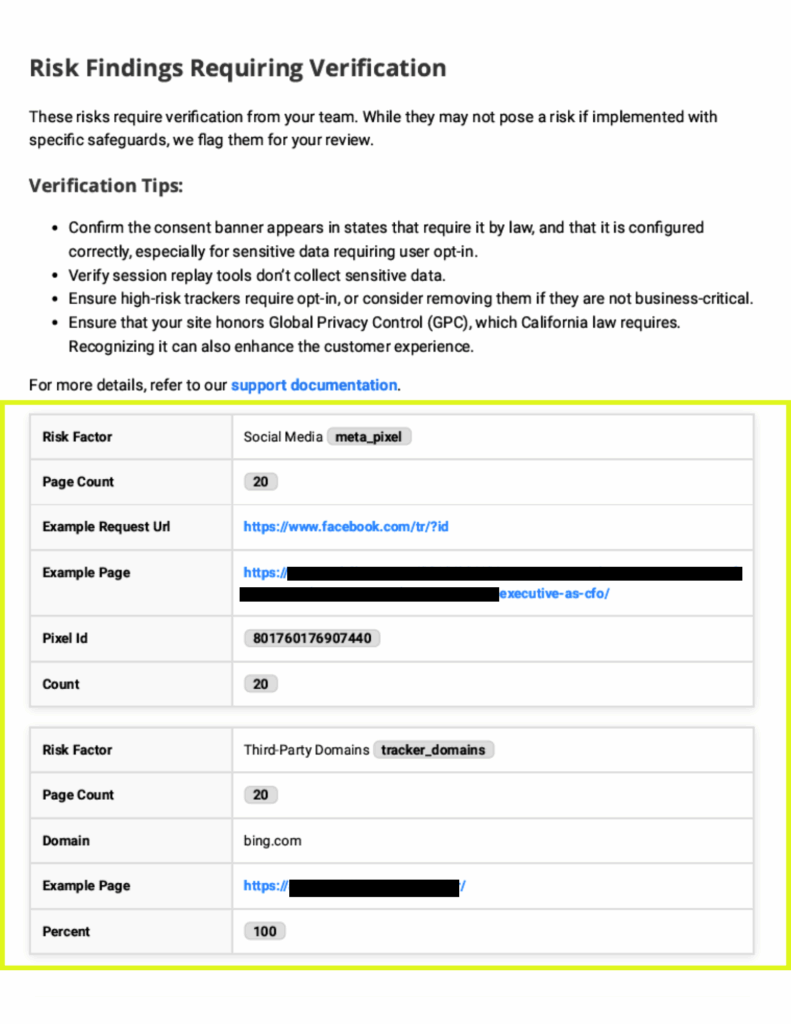
Critical Risk Remediation - additional report screenshot

High Risks

Understanding Verification Risks

Risks that have been identified as requiring additional information from you to verify the risk to your company.

Social Media Domain

This risk assessment indicates that a social media website is currently receiving data from a specific page on your website. This data has been classified by Lokker as containing sensitive consumer Health Care information. Several US states, e.g. Washington, have explicitly blocked this type of data sharing. The transmission of this data to an external social media site raises concerns around data privacy and potential non-compliance with relevant healthcare regulations.

AttributeAdditional InformationDescription
Risk FactorVerification is the second highest level of risk.Verification
SpreadThis is the number of scanned pages (20) and the number of pages on your site (20) with this risk was found.Found on 20 of 20 pages inspected
DescriptionA social media third party tag was found on a page on your site with consumer health care information.Social Media Domain Critical
IndustryThis indicates the industry classification of the page on your site with the risk.Medical Devices and Supplies
Example PageThis is an example of a page containing healthcare information and a tag which shares data. There may be additional pages with risk.https://blueskybio.com/pages/cache-test
Example Request DomainHosting website of the third party tag found on the page.facebook.net
Example Request URLThe complete URL of the third party which is receiving information from your site.https://connect.facebook.net/en_US/all.js#appId
Social Media SiteThe social media platform receiving data from your site.Facebook
CountNumber of pages where this risk was found.20
Pages ImpactedThe names of one or more pages on your site where this risk was found.https://example.com/pages/about-us, https://example.com/pages/bioconus-12
Third-Party Domains

Lokker detects the number of third-party domains on websites and compares the overall number and type to the S&P 500 and other industries to determine if a website is better, comparable, or significantly worse than the baseline. These third parties increase the need for you to monitor for unauthorized data collection and proper governance. Often, third parties are not placed by you directly but are instead piggybacking on another script. The website owner remains responsible, even if they didn't directly place the script themselves.

AttributeAdditional InformationDescription
Risk FactorVerification is the second highest level of risk.Third-Party Domains
Page CountNumber of pages where this risk was found.20
DomainAn example of a third party domain used for sharing data.adnxs.com
Example PageThis is an example of a page with one or more third party domains used for sharing data. There may be additional pages with this risk.https://example.com/blog/why-automate/
PercentThe percent of pages on your site containing third party domains.100%
CIPA Wiretapping Risk

The California Invasion of Privacy Act (CIPA) is a state law that safeguards the privacy rights of California residents by imposing strict regulations on the recording and monitoring of conversations and communications. When third party session replay tools are used on a website, data sent to the third party enables it to know all the actions the user has taken on the web site. HotJar and Dynatrace are examples of session replay tools.

  • Consent: CIPA generally mandates that all parties involved in a communication must provide consent before any recording can take place. This consent must be explicit and cannot be assumed or implied.
  • Notice: In situations where recording is permissible, CIPA may require that parties be given clear and conspicuous notice that the communication is being recorded.
  • Scope: The law's scope extends beyond private conversations to encompass communications in public spaces and workplaces, provided that there is a reasonable expectation of privacy.
  • Penalties: Violations of CIPA can result in severe consequences, including civil lawsuits for damages, injunctions, and potentially criminal prosecution.
AttributeAdditional InformationDescription
Risk FactorVerification is the second highest level of risk.CIPA Wiretapping Risk
Page CountNumber of pages where this risk was found.20
DomainHosting website of the session replay tool found on the page.clarity.ms
Example PageThis is an example of a page with one or more third party domains identifying session replay tools. There may be additional pages with this risk.https://backbox.com/blog/eight-rules-of-backup/
PercentThe percent of pages on your site containing session replay tools.100%
High Risk Tracker Detected

This assessment checks for the presence of any of the following tags which have been identified as high risk: adnxs.com, bing.com, addthis.com, sharethis.com, bluekai.com.

AttributeAdditional InformationDescription
Risk FactorVerification is the second highest level of risk.Third-Party Domains
Page CountNumber of pages where this risk was found.20
DomainHosting website of the high risk third party found on the page.adnxs.com
Example PageThis is an example of a page with one or more high risk third party domains. There may be additional pages with this risk.https://example.com/2023/09/05/acertus-acquires-rcg-logistics/
PercentThe percent of pages on your site containing high risk session replay tools.100%

Take Action on Your Privacy Risks Today

Need more details? If you have questions or want a deeper analysis, reach out, we're happy to help.

  • Fix Privacy Issues Fast: We'll identify and resolve risks from your report.
  • Stay Protected: Ongoing monitoring keeps your site secure.
  • Simplify Compliance: Upgrade consent management for a seamless, law-compliant experience.